
Forms Shaped by Constraint
Lately I’ve been thinking about the tension I sometimes feel in my own making.
On one hand, I’m deeply process-driven. I like responding to materials in the moment, letting fabric and thread lead, rather than starting with a fixed plan. On the other hand, I’m consistently drawn to naïve art and stylised images of nature. Folk florals, animals, decorative forms that aren’t concerned with accuracy.
Playful, childlike shapes and lines, quirky animals, depictions of people and nature. Simplistic and honest, not trying too hard. Work that feels closely connected to the hand, to domestic life, to working the land. I think of Bill Traylor’s sketches, Harriet Powers’ pictorial quilts, the illustrated ceramics of Makoto Kagoshima.
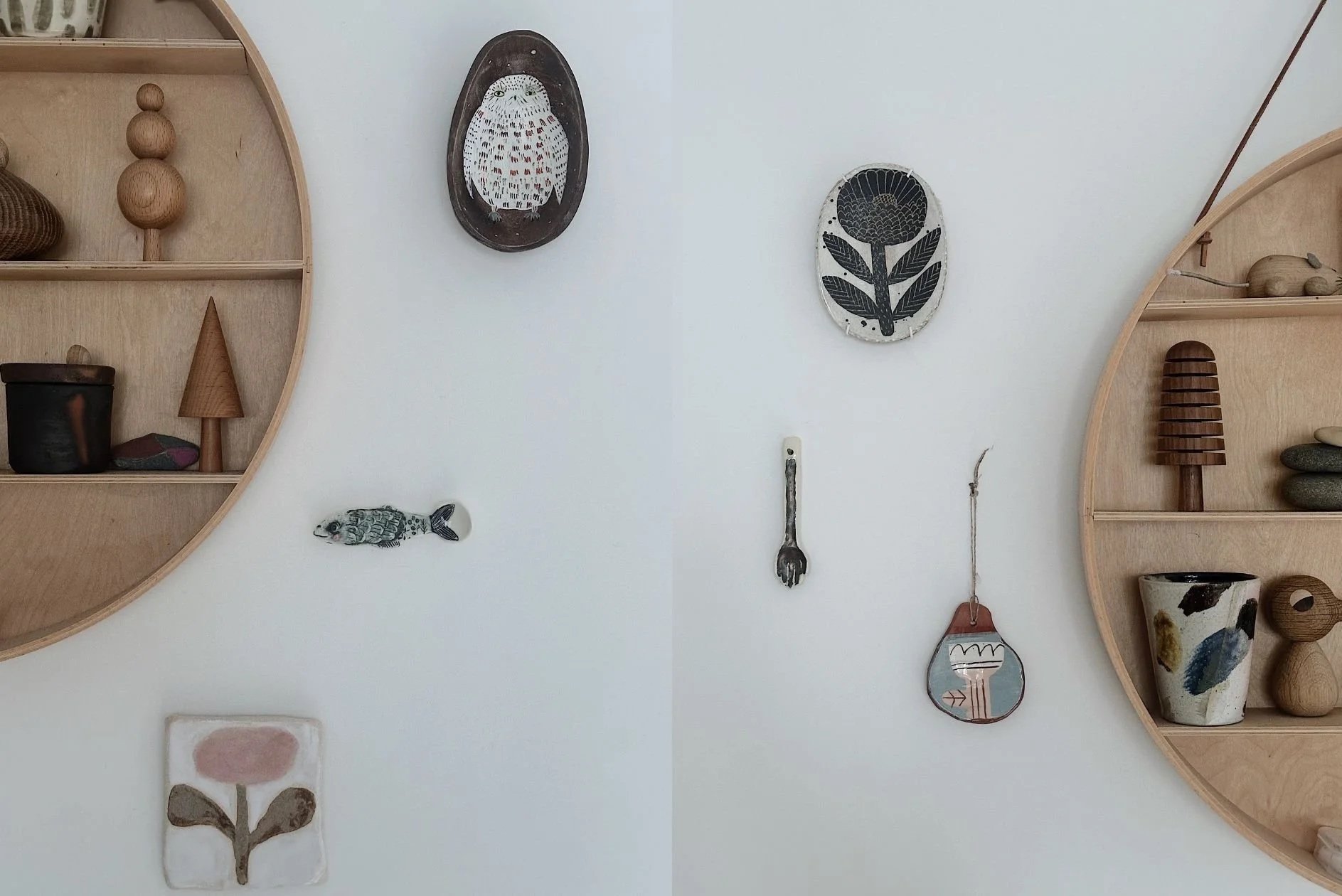
A collection of folk inspired objects displayed in my home
These are objects and images I am drawn to and choose to live with, displayed around my home and balanced by lighter, quieter spaces. It is hard not to soak up their influence.
Tension Between Process and Aesthetic
For a while, these two ways of working have felt slightly at odds. I began to wonder whether the same balance I enjoy when living with these objects could exist within my own textile practice. When I am making just for myself, not for a workshop or for content, I feel oddly stuck. I have wanted to make a body of work around the idea of abstract florals for some time now. There are many ideas circling in my head, but I have struggled to translate them in a way that feels honest.
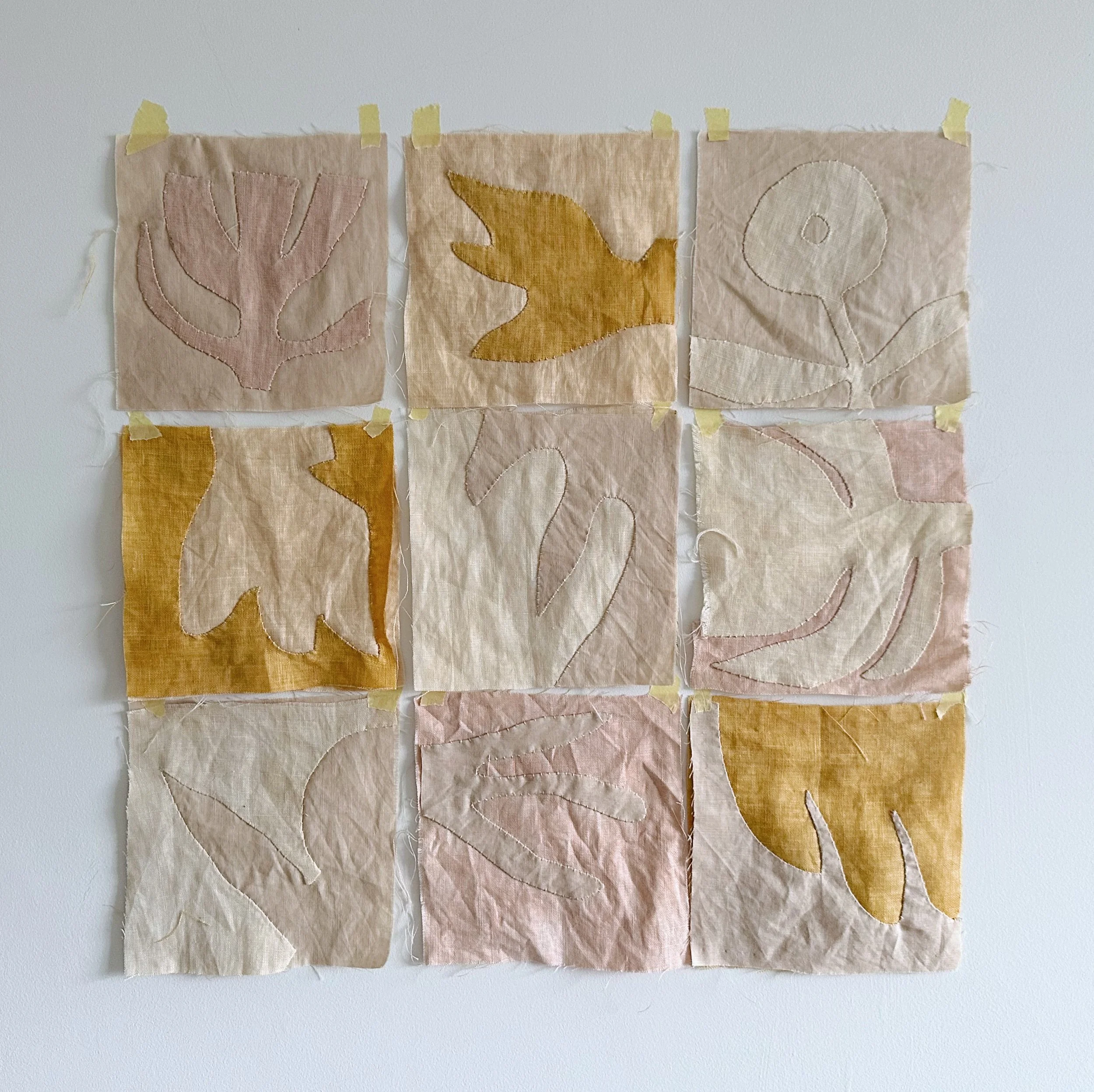
I’ve touched on florals before. In my zero-waste abstract appliqué tutorial, the shapes were floral-inspired, cut from squares of fabric, using both the positive shape and the negative space left behind. I showed several possible ways of arranging the blocks, deliberately not settling on a final design. Even now, I still haven’t decided where some of those pieces will live, though I suspect they’ll find their way into my seasonal scroll as it shifts towards spring.
I returned to abstract florals again when I made a block for the Liberty quilt, sadly not picked, stepping well outside my comfort zone by working with floral fabrics. And of course, there’s the quilted flower tutorial, which leans much more openly into the folk aesthetic I love. Still, something has felt unresolved, and I have been unable to take this idea any further.
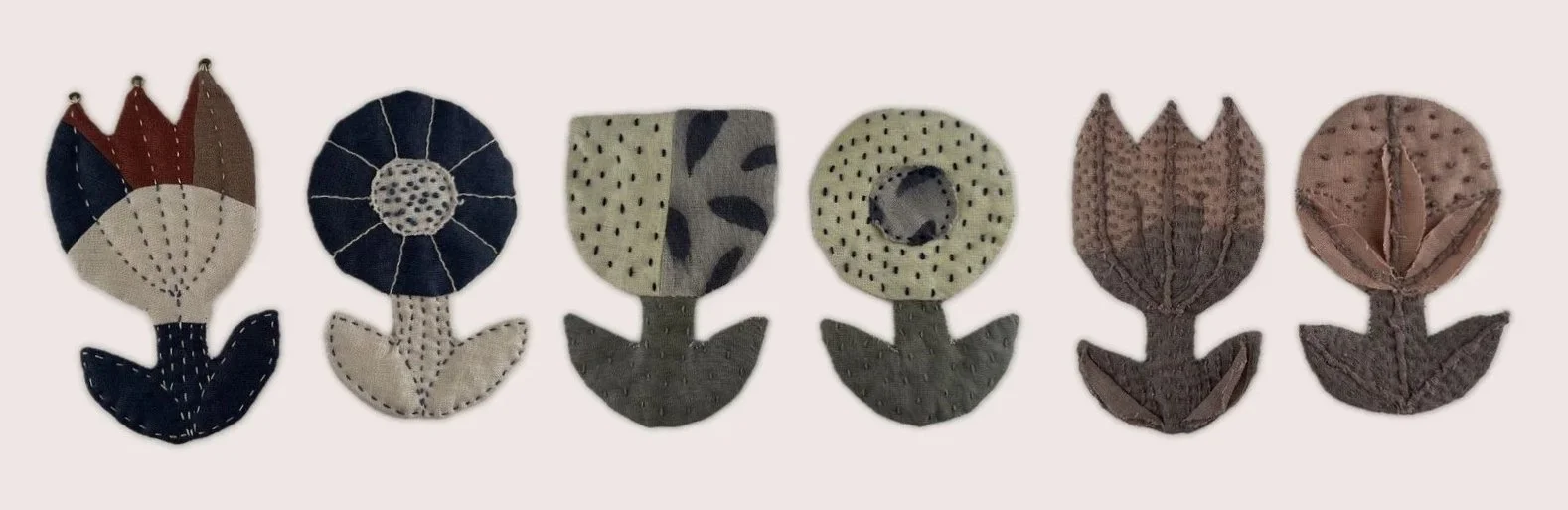
Flowers in the ‘Make a Flower Mini Quilt’ tutorial
I began to question whether my ideas were under-researched. Was I trying to jump straight to an outcome without putting in the work beforehand? I felt that I needed to return to drawing, but my drawings left me feeling unsatisfied. They were either too accurate and not at all the aesthetic I wanted to convey, or too made up, looking contrived and over-stylised.
I can get frustrated with myself that my creativity often arrives in short, intense bursts. I become absorbed in a particular process or technique and make a small sample. That sample feels exciting and full of possibility, but it often stays exactly that, a fragment, before my attention moves elsewhere.
For a long time now, I have accepted that having many different things on the go at once is essential for my busy brain. It keeps me engaged, curious, and open. I love the spark I feel when the urge to make takes over. It gives me a genuine buzz, something I would never want to lose.
At the same time, I worry that my textile practice can appear disjointed, that there is no clear thread running through the work. Drawing felt like a way of bringing everything together, of becoming more disciplined, perhaps returning to how projects were approached at school, college, or university. I hoped it might offer structure or continuity.
Instead, it left me feeling worse. The drawings felt forced and disconnected from how I naturally work. Trying to impose a method that no longer fit only highlighted the distance between expectation and instinct.
A small moment of clarity
Recently, while visiting the Yorkshire Sculpture Park with my daughter and a friend, we spent time in the studio space after seeing the William Kentridge exhibition. I have visited the Yorkshire Sculpture Park for years and always make a point of spending time in the studio. The learning resources are generous and thoughtfully designed to encourage exploration rather than outcomes.
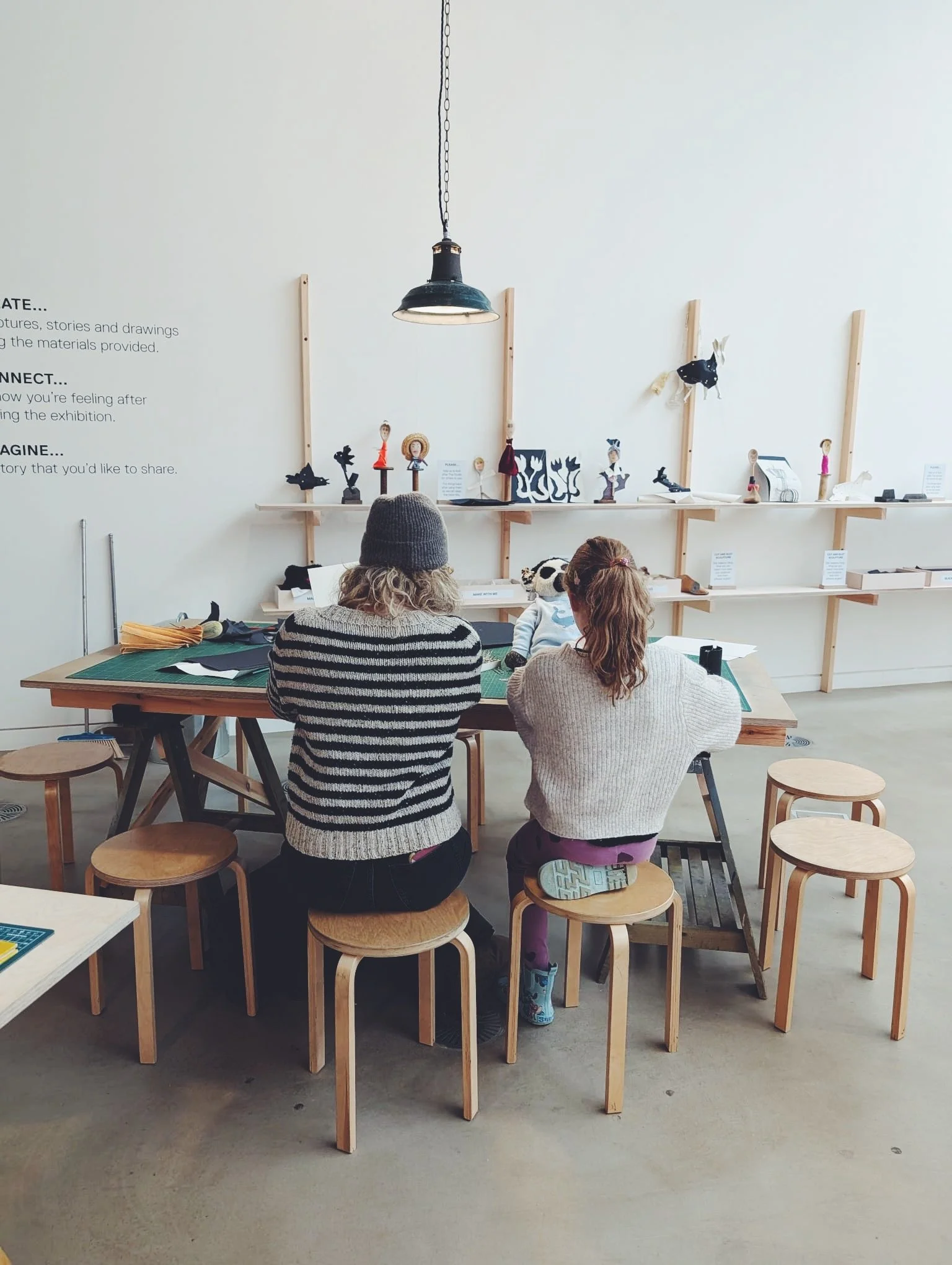
Collaging in the Studio at the Yorkshire Sculpture Park
Both my daughter and I love spending time there. She has been visiting since she was a toddler, and we often spend an hour or more drawing or making things in response to what we have seen. That space has quietly modelled a way of learning I value deeply, one rooted in curiosity, play, and responding rather than producing.
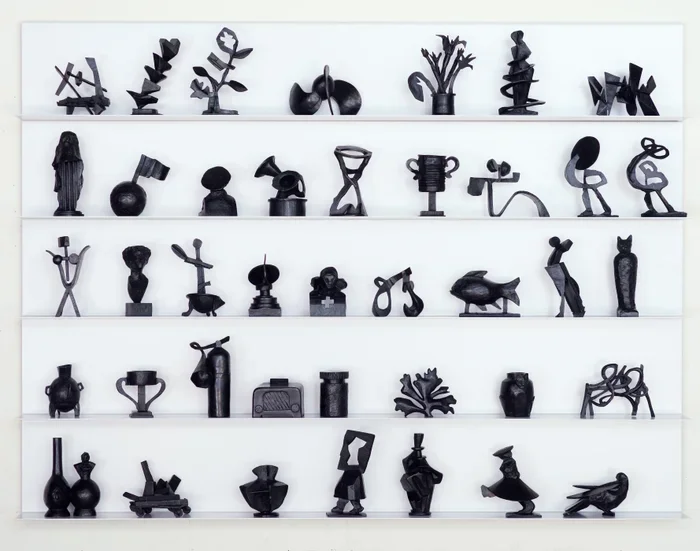
Cursive, 2020, by William Kentridge. Photograph: Thys Dullaart/© William Kentridge
The subject matter of the William Kentridge exhibition is very different from my own work, but I felt an immediate connection to his use of materials and his sensitivity to form and negative space. His maquettes, made from newspaper, brown tape, and other simple materials, reminded me of modules on my foundation art course. Strong, mid-century silhouettes sit against white backgrounds, with the negative space as active and compelling as the shapes themselves. his large metal sculptures feel like the outcome of playful exploration rather than fixed intention, torn paper reconstructed and translated into something monumental. Seeing not just the finished works, but glimpses of his inspirations and processes, shifted something in me. I carried that way of thinking with me as I began to make.
This time, the materials were simple: black and white A4 card, paper clips and split pins, with no glue, tape, or scissors, and a small selection of coloured pencils.
Having felt disappointed by my drawings in the past, I decided not to draw at all, at least not in the conventional sense. Instead, I drew by tearing. A nod to Matisse, perhaps, but also a return to something more physical and intuitive.
I worked within the rectangle of the page, trying to use as much of the space as possible, allowing a floral form to grow and press against its edges. I tore the shape in one continuous piece, paying attention to both what I removed and what remained. This was not a new way for me to work, but it felt as though I was discovering something for the first time.
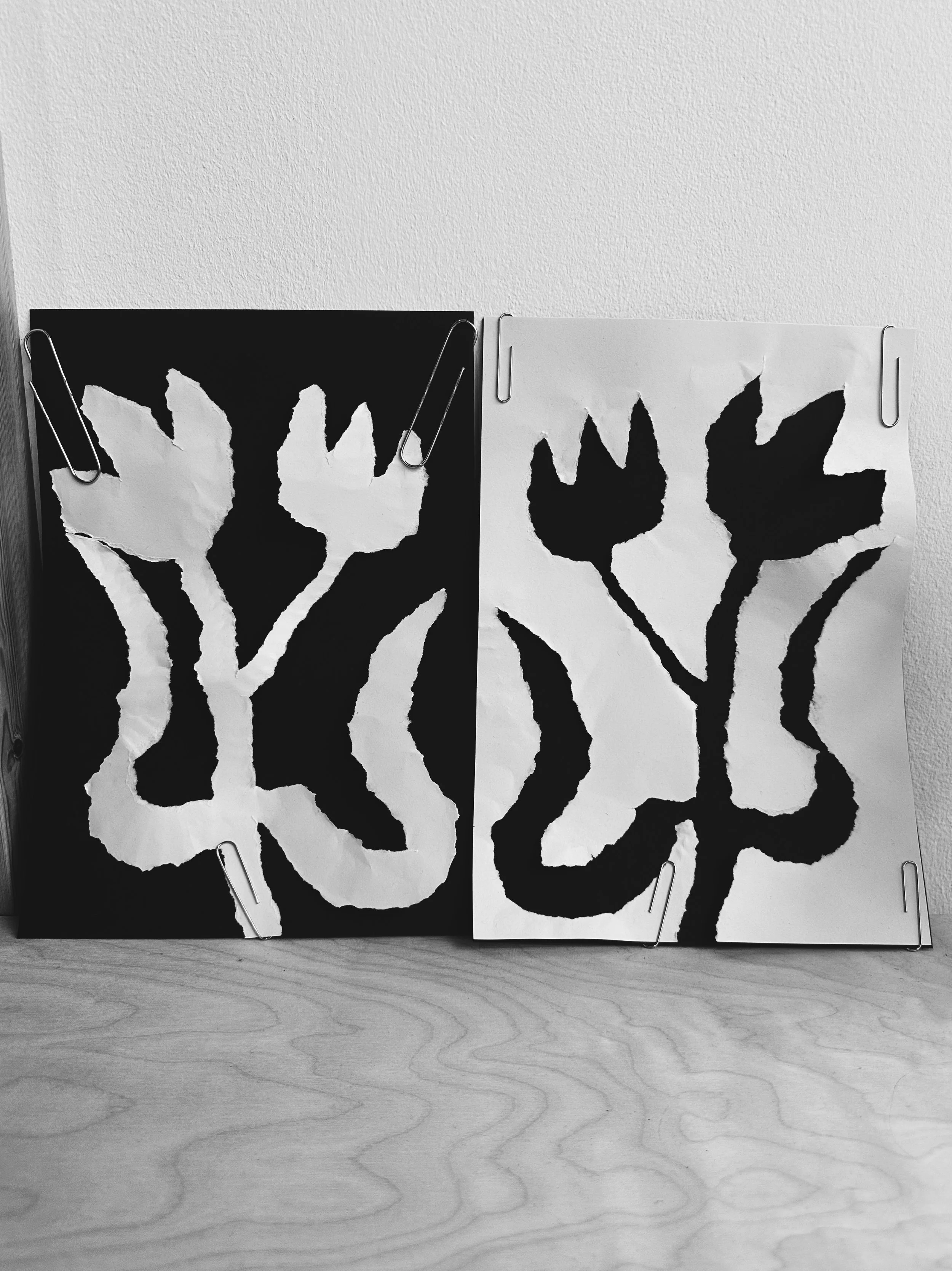
When I placed the white positive shape onto a black background, and then flipped the black negative onto white, I realised I had created two drawings, mirror images of each other. Without consciously intending to, I had made a kind of notan, a study of balance between light and dark, presence and absence.
The result surprised me. The forms felt raw, spontaneous, and far less contrived than my earlier sketches. More importantly, they felt familiar.
Flowers shaped by their environment
What I’m interested in here isn’t botanical accuracy. These aren’t drawings of real flowers. They are flowers from memory or imagination, or perhaps feelings disguised as florals.
Conceptually, I’m drawn to the idea of something organic negotiating a man-made, geometric structure. A flower trying to grow within a square. A stem bending around a right angle. Growth that doesn’t have enough space, but finds a way anyway.
Art Nouveau florals come to mind, but stripped back, less ornamental and more restrained. Curves responding to straight lines. Nature adapting rather than flourishing.
There’s something in this that feels very relevant to the wider world at the moment. Being shaped by our environments. Learning how to live, grow, and care within constraints that we didn’t choose.
Coming back to myself
What this small experiment reminded me is that not all drawing needs to be pencil on paper. Tearing, cutting, and assembling are all forms of drawing too. This way of working feels much closer to how I approach fabric: found shapes, negative space, and the quiet importance of what’s left behind.
Interestingly, after making these collage drawings, I returned to pencil and paper, and suddenly that flowed more easily too. Something had loosened.
The black and white is starker than I usually work, so I am curious to see what happens when I begin to introduce softer, more muted tones. Perhaps painted papers, brown paper, or printed surfaces. I am also interested in what might shift when I introduce a textured fabric, allowing the material itself to influence the form.
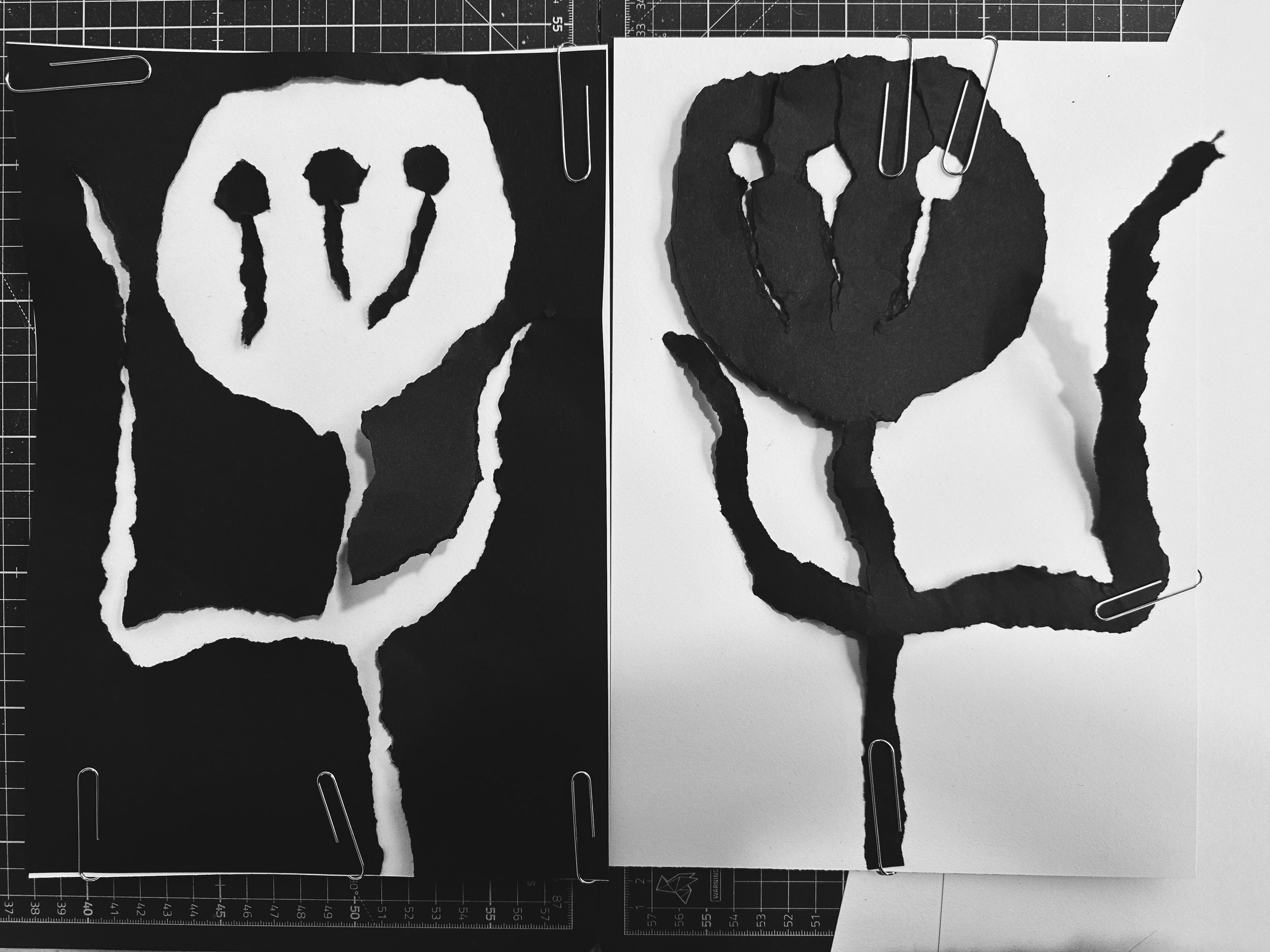
For now, my plan is simple. More quick, unpressured drawings. More collage. More curiosity. Letting ideas move between paper and cloth without forcing them into a final form too soon. Using my fingers to tear and find shapes loosely based on florals. Forms that grow, curve, and bend around a square. Shapes that adapt, that push against constraints, that find a way to exist within them.
I want to hold onto the same rawness I felt in those first torn drawings, to resist the urge to refine too quickly. To give myself permission to make mistakes, to follow dead ends, and to allow things to feel unresolved. Often it is in these moments that the work feels most alive, before it settles into something named or defined.
I do not need answers yet. I am simply making space to keep looking.